Quick Takeaways (18 min read)
- ▸The migration is a continuous, year-round circular journey of 1,200km — not just the Mara River crossings
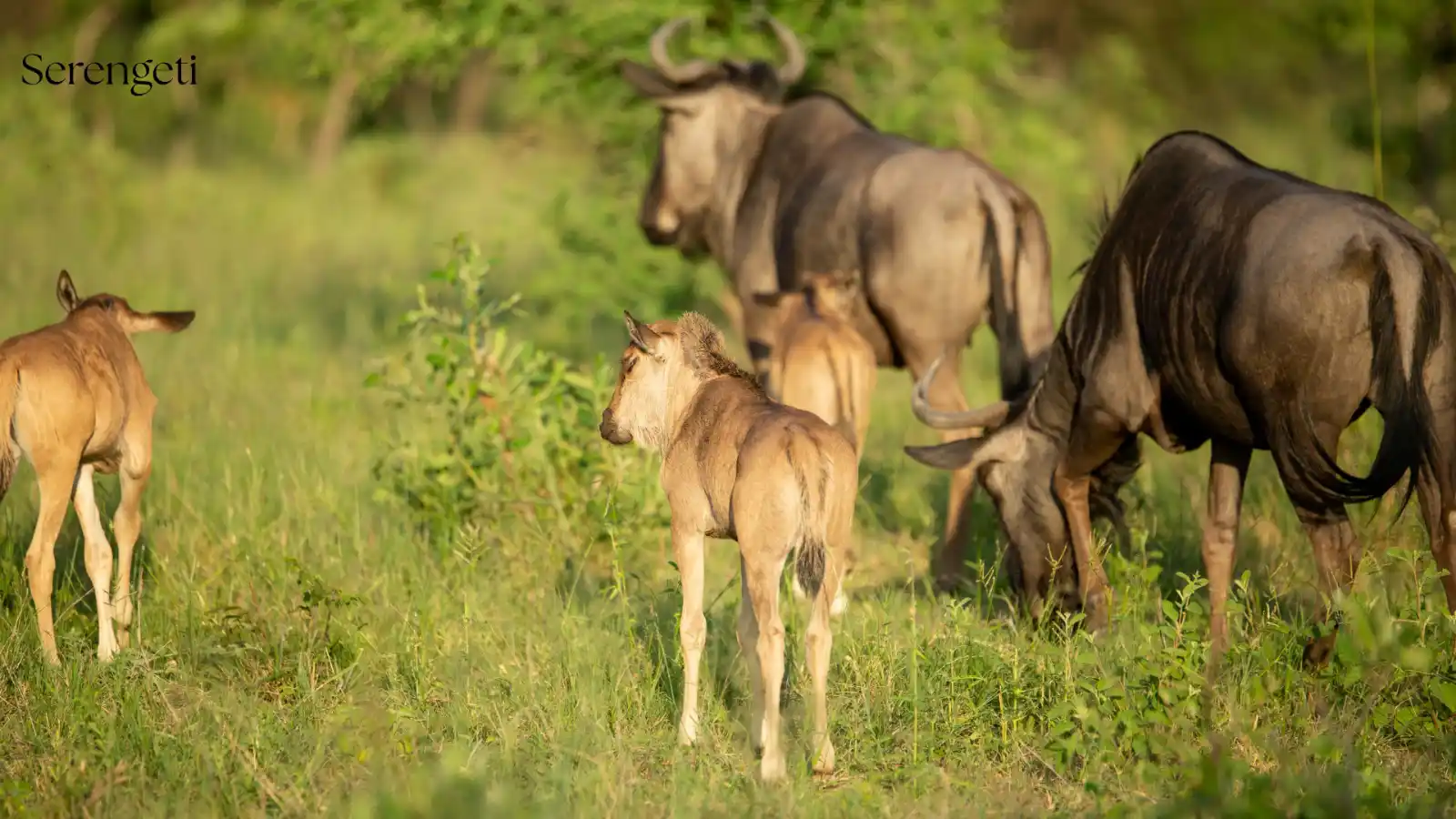
- ▸Up to 500,000 wildebeest calves are born in just 3 weeks in Ndutu (Jan–March) — happening right now
- ▸200,000 zebras travel alongside wildebeest in a cooperative food-chain partnership
- ▸The decision to cross the Mara River has no leader — it emerges through predator-swamping threshold behaviour
- ▸The Western Corridor (Grumeti River, April–June) offers dramatic crossings with far fewer tourists
Ask most people what they know about the Great Wildebeest Migration and they'll tell you the same story: enormous herds throwing themselves into the Mara River, crocodiles lunging, chaos and survival in equal measure. It's one of the iconic images of African wildlife. But it's also just one chapter in a story that never pauses, never repeats exactly, and operates according to rules that scientists are still working to fully understand.
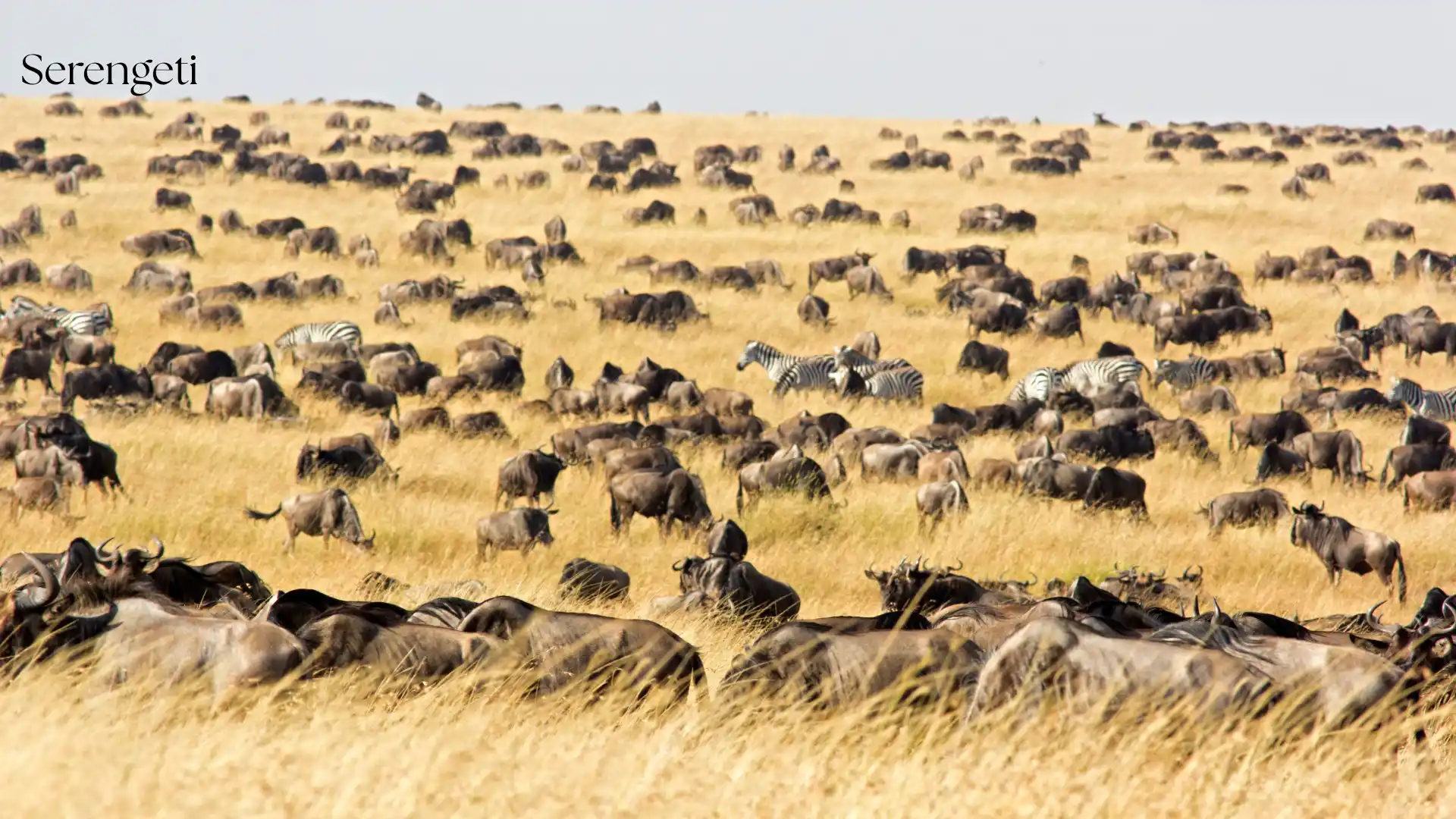
The migration isn't an event. It's a perpetual motion — 1.3 million wildebeest, 200,000 zebras, and half a million Thomson's gazelles locked in a circular journey that covers 1,200 kilometres every year, driven not by instinct alone but by grass chemistry, rainfall radar, and emergent collective intelligence. Right now, as you read this in March 2026, hundreds of thousands of newborn wildebeest calves are taking their first steps in the Ndutu plains of southern Serengeti. This is the migration too. And in many ways, it's the most astonishing chapter of all.
🌍The Migration Never Stops
Here is the single most important thing to understand about the Great Migration: there is no off-season. The herds are always moving. The question is simply where they are in their 1,200-kilometre annual loop — and what drama that location produces.
The route traces a roughly clockwise circuit through the Serengeti-Mara ecosystem, one of the last places on Earth where this kind of large-scale wildlife movement still occurs. Starting in the short-grass plains of the southern Serengeti and Ndutu area (roughly January to March), the herds follow the rains northward through the central Seronera region in April and May, push into the Western Corridor along the Grumeti River in June, then accelerate north into the Masai Mara in Kenya from July through October, before looping back south through the northern and eastern Serengeti in November and December.
Each phase of this journey produces distinct, extraordinary wildlife experiences. The Mara River crossings in July–October are justifiably famous because they're concentrated, dramatic, and photographically spectacular. But they represent perhaps four months of a twelve-month spectacle. Travelers who limit their understanding to the crossings are missing two-thirds of the story — including some chapters that are arguably more moving.
The Migration at a Glance
The Great Migration is not an event with a start and end date — it is a continuous, year-round circuit that has been running for over one million years.
🐣Calving Season: The Forgotten Spectacle
Between January and March, the southern Serengeti and Ndutu area in Tanzania experience something that has no parallel in the natural world: a mass birth event so precisely synchronised that it borders on the miraculous.
Approximately 500,000 wildebeest calves are born within a window of just two to three weeks. On a peak day in February, tens of thousands of newborns may arrive simultaneously across the short-grass plains. The timing is the result of millions of years of evolutionary pressure, and it produces a strategy known to ecologists as predator swamping.
The logic is simple and brutal: predators can only eat so many animals at once. If all the vulnerable newborns arrive simultaneously, the predators — lions, leopards, cheetahs, hyenas, jackals, wild dogs — are overwhelmed by sheer abundance. Even at their most frenzied, they can only kill a fraction of the calves born on any given day. A calf born in the middle of the peak window has a dramatically better survival chance than one born early or late, when predators are hungry and focused.
What makes the scene so extraordinary for visitors is the combination of raw tenderness and genuine peril playing out across the same plain. A newborn wildebeest can stand within five minutes and run within fifteen — one of nature's most compressed developmental milestones. Alongside the births, predators hunt with barely contained urgency. Cheetah mothers with cubs of their own are hunting for two survival imperatives at once. Lion prides fan out across the grass. Spotted hyenas trot in loose clusters, reading the wind.
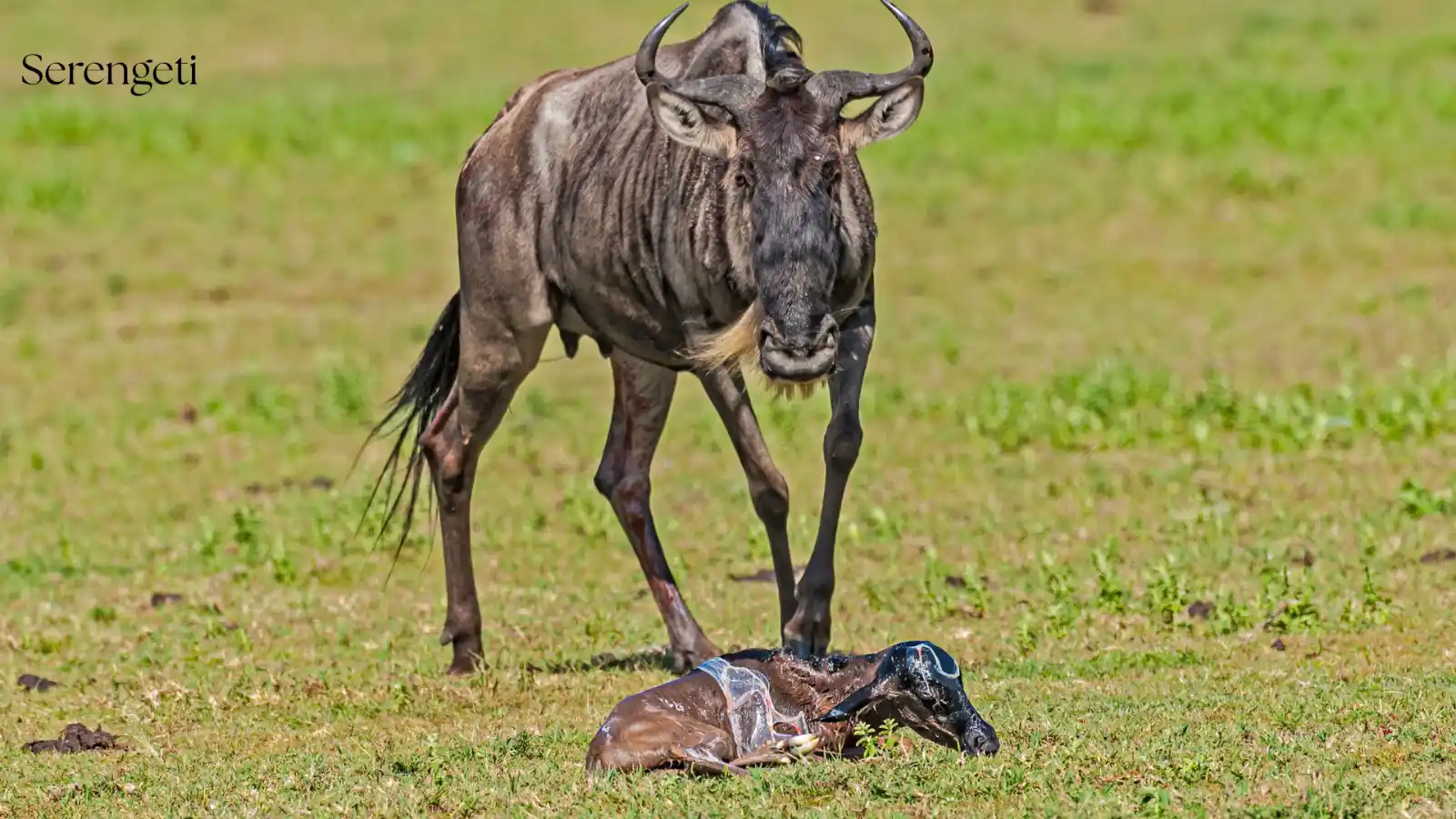
Calving season is happening right now — in March 2026, the southern Serengeti plains are thick with young animals. It receives a fraction of the tourist attention that the Mara River crossings attract, which means you share the experience with fewer vehicles and more space. The grass is short, the sky is enormous, and the air carries the particular electric quality of a landscape that is producing life at maximum speed.
Our 7-Day Calving Migration Safari is specifically designed around this window, combining Ndutu with the Ngorongoro Crater and central Serengeti for a complete southern circuit.
500,000 wildebeest calves born in three weeks — nature's answer to predator pressure, and one of the most extraordinary sights in all of wildlife travel.
Calving season produces up to 500,000 wildebeest births in just 2–3 weeks, using predator swamping as a survival strategy — and it's occurring right now in Ndutu.
🦓Zebras Go First
The migration is not a single species event. Travelling alongside the wildebeest are approximately 200,000 plains zebras and half a million Thomson's gazelles. Their presence is not incidental. It is ecological.
Zebras consistently lead the migration northward, moving ahead of the wildebeest herds by days or even weeks. For years, naturalists assumed this was simply because zebras are faster and more independent. The real explanation is more elegant: zebras eat the coarse, tall grass that wildebeest cannot efficiently process. As they move through, zebras crop the outer stem layer of the grass, exposing the lower, more nutritious leaf layer underneath. The wildebeest follow directly into a landscape that zebras have, in effect, already prepared for them.
The gazelles, meanwhile, feed on the short-cropped regrowth left behind by both zebras and wildebeest. The result is a three-tier grazing succession that efficiently extracts maximum nutrition from the same stretch of grassland without direct competition between species. This kind of multi-species facilitation — each species improving the environment for the next — is rarely observed at such scale anywhere on Earth.
For the safari traveler, this means that tracking the migration is also an exercise in reading landscape. Where you see zebras moving purposefully in a particular direction, wildebeest will follow. The zebras are, in a sense, advance scouts — and observing the relationship between the species transforms what might appear to be a random aggregation of animals into something that reads almost like orchestration.
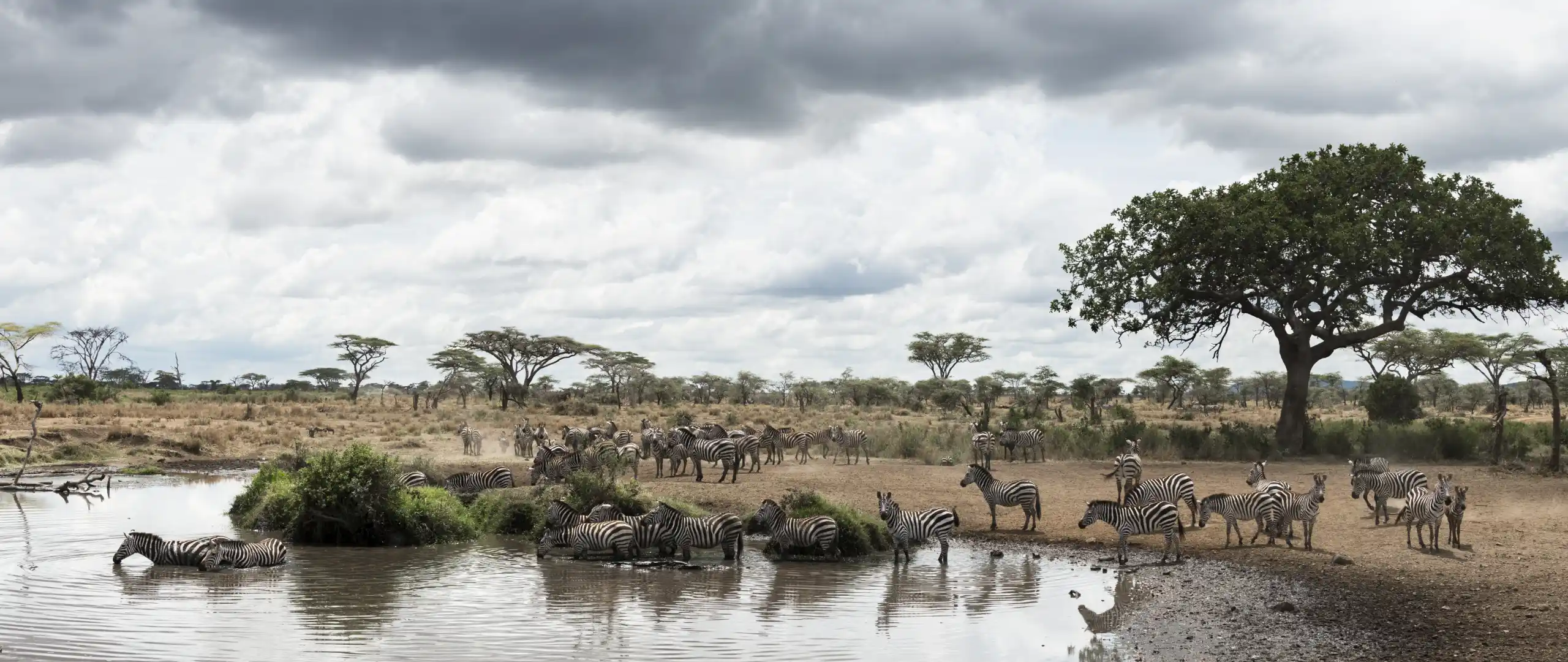
The Three-Tier Grazing Sequence
Zebras lead the migration because they eat tough outer grass, exposing the nutritious shoots wildebeest need — a cooperative relationship that has co-evolved over millions of years.
🌊The Science of River Crossings
The Mara River crossings are the migration's great theatre. Between July and October, wildebeest herds accumulate on the Tanzanian bank, sometimes in concentrations of thousands, staring at the water below. Hours can pass. Then, suddenly, they go.
For decades the crossing behaviour puzzled scientists. There is no single animal that leads — no dominant bull that makes the decision on behalf of the herd. What researchers have found instead is a process that operates through what complexity theorists call threshold behaviour, or a phase transition.
As more animals gather at the bank, the collective agitation in the herd builds. Individual animals test the edge, retreat, test again. The density of animals near the water increases. At a particular threshold — which depends on herd size, predator presence, water level, and factors scientists still cannot fully predict — the system tips. The first animal enters the water, and within seconds hundreds follow, creating a momentum that is almost impossible for the animals behind to resist. There is no leader. The decision emerges from the herd itself.
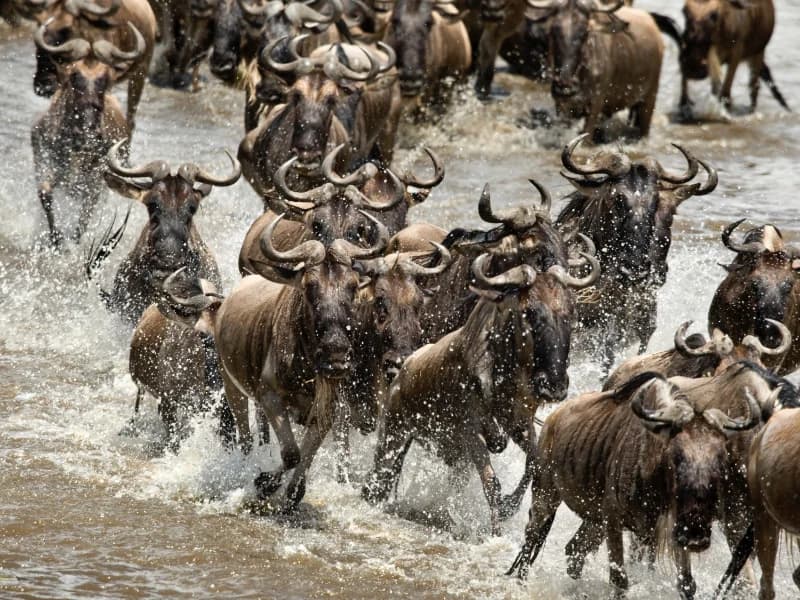
The Mara River is home to some of the largest Nile crocodiles in Africa, animals that can reach over five metres in length and weigh more than 700 kilograms. They position themselves along the banks months in advance of the crossing season, learning the herd routes from decades of experience. Despite their size and persistence, crocodiles kill a relatively small percentage of crossing wildebeest — perhaps 0.1 to 0.2 percent. The mathematics of predator swamping applies here too: simply too many animals crossing for any predator to significantly reduce the herd.
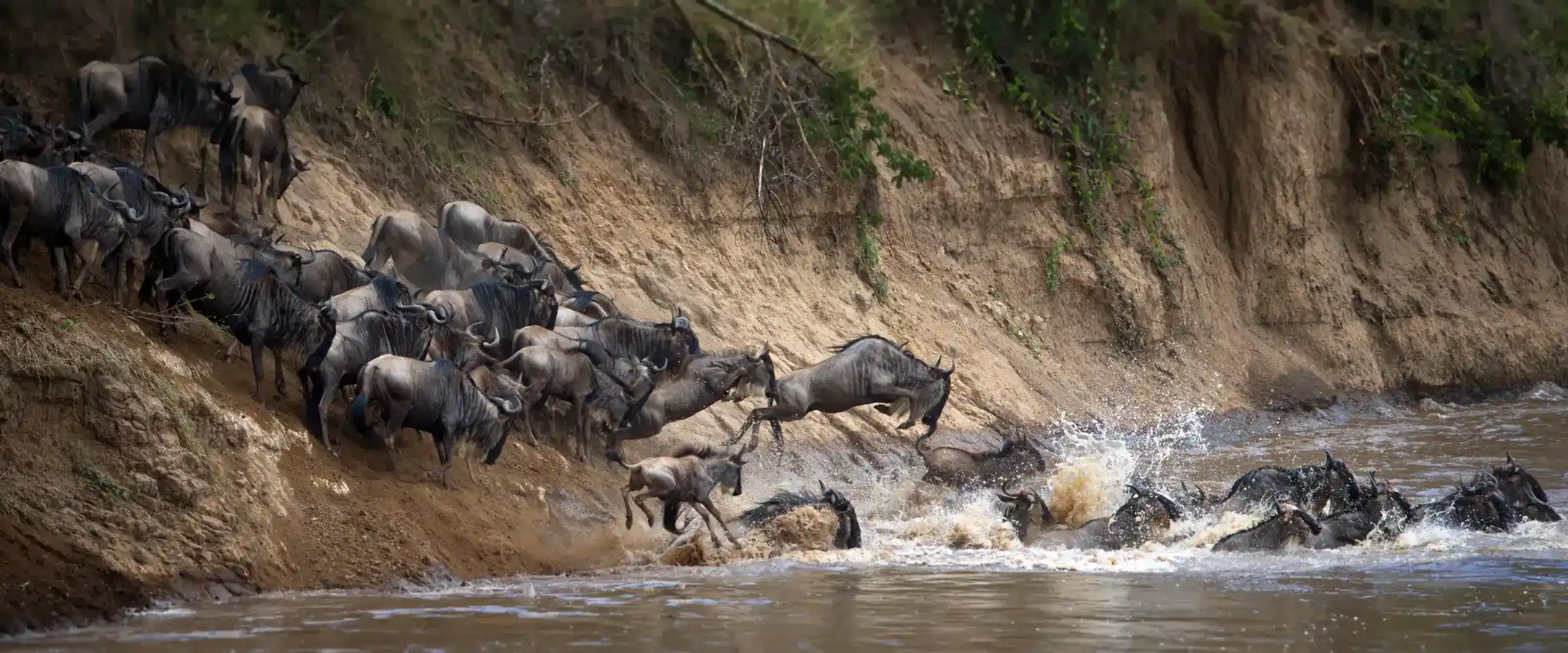
What kills far more wildebeest at the crossings is not predation but drowning, crushing, and exhaustion. Animals at the back of a crossing surge can be pushed underwater by the weight of those behind. Steep exits force injured and old animals to fail on the bank. Bodies accumulate in quieter bends of the river — a macabre but ecologically vital contribution to the river ecosystem, feeding fish, crocodiles, vultures, and marabou storks for weeks.
The crossings happen multiple times. The same stretch of river may be crossed and recrossed dozens of times through the season as the herds move in their irregular loops. There is no single crossing event. Repeat visits within the same week at the same location can yield completely different experiences.
No single animal decides to cross the Mara River. The decision emerges from the herd itself — a phase transition that happens when collective agitation reaches a tipping point.
Mara River crossings are not led by any individual animal — the decision emerges through collective threshold behaviour, a form of emergent intelligence scientists are still working to fully understand.
🐊The Western Corridor: Africa's Hidden Crossing
Ask experienced safari travellers and guides which migration experience they consider most underrated, and a significant number will name the Western Corridor. Between April and June, as the herds begin their northward push, they reach the Grumeti River — and what happens there is almost identical to the Mara crossings, but with a fraction of the audience.
The Grumeti is home to enormous Nile crocodiles, in some cases surpassing those of the Mara in size and age. These animals have had decades of occupation in a single stretch of river, and their behaviour during the crossings is, if anything, more calculated than their Mara counterparts. The Grumeti crossings tend to be more compact — short, sharp, intensely dramatic — partly because the river is narrower and the available crossing points more limited.
Beyond the Grumeti, the Western Corridor offers different scenery and atmosphere from the famous northern plains. The landscape is characterised by woodlands, kopjes (granite outcrops), and seasonal swamps. Topi and roan antelope — species rarely seen on the northern circuit — are common. Bird diversity is exceptional. And the sense of space and solitude that has been eroding from parts of the northern Serengeti remains largely intact in the west.
For photographers, the Western Corridor presents different compositional possibilities: wildebeest moving through acacia woodland rather than open grassland, the scale of the landscape compressed into more intimate frames, and predator encounters that happen without the surrounding ring of vehicles that can characterise peak season in the Masai Mara.
Western Corridor vs Northern Serengeti
The Grumeti River crossings in the Western Corridor (April–June) offer drama equal to the famous Mara crossings, with a fraction of the tourist presence.
💀When the Herds Nearly Vanished
The 1.3 million wildebeest that move through the Serengeti today represent one of conservation's most remarkable recoveries — a story that very few travel articles bother to tell.
In the late 19th century, a catastrophic rinderpest epidemic swept across sub-Saharan Africa. Rinderpest is a viral disease related to measles, and it devastated both domestic cattle and wild bovines with extraordinary efficiency. In Tanzania alone, the epidemic is believed to have killed approximately 95 percent of the wildebeest population. Where millions of animals had moved across the ecosystem, only tens of thousands remained. The circular migration continued, but in ghost form — a skeletal remnant haunting a landscape that had once vibrated with its passage.
Recovery was painfully slow. The wildebeest population remained suppressed through the first half of the 20th century — not by rinderpest alone, but by unregulated hunting, habitat conversion, and the introduction of cattle diseases that continued to suppress the immune systems of wild bovines. As late as the 1950s, scientific estimates placed the Serengeti wildebeest population at around 250,000.
What turned it around was a combination of veterinary intervention and conservation policy. A cattle vaccination program that began in the 1960s dramatically reduced rinderpest transmission between domestic cattle and wildebeest. As the disease pressure lifted, wildebeest reproductive capacity finally had room to operate. Numbers climbed: 350,000 in 1965, 700,000 in 1972, over one million by 1977. The entire Serengeti ecosystem shifted — measurably, demonstrably — as the wildebeest population returned to its ecological role.
The lesson is one that every conservation biologist cites: keystone species are not replaceable components. Remove the wildebeest, and you do not simply lose wildebeest. You lose the Serengeti as a functioning ecosystem. Bring them back, and the land itself recovers.
Global rinderpest was officially declared eradicated by the World Organisation for Animal Health in 2011 — only the second disease in history to be eradicated by human intervention, after smallpox. The wildebeest's survival is, in part, a medical triumph. When you watch the herds move across Serengeti National Park, you are witnessing the result of that triumph.
In the 1890s, rinderpest killed an estimated 95% of Serengeti wildebeest. The 1.3 million animals moving across the plains today represent one of conservation's great recoveries.
The Great Migration nearly ceased to exist — rinderpest killed 95% of Serengeti wildebeest in the 1890s, and the full recovery only completed in the 1970s.
📅When to Go: Month by Month
Understanding where the herds are — and what you'll witness — in each month of the year allows you to match your visit to the experience you're specifically seeking. There is no single best time; there is only the best time for what you want to see.
**January – March: Calving Season in the Southern Serengeti and Ndutu** This is where the herds are right now (March 2026). The short-grass plains around Ndutu and the Ngorongoro Conservation Area are covered with wildebeest, newborn calves, and the predators that follow them. Visibility is exceptional on the open plains. Tourist numbers are moderate — lower than peak Mara season — and the experience is profound. Our 7-Day Calving Migration Safari is designed specifically for this window.
**April – May: Long Rains and the Push Northward** April brings the long rains, and with them the herds begin to consolidate and move northward through central Serengeti toward the Western Corridor. This is one of the quietest periods for tourism — partly because rain interrupts some game drives, partly because the Mara crossings are still months away. This quiet is precisely why experienced safari travellers choose it: far fewer vehicles, excellent wildlife, dramatic skies, and vivid green landscapes. The Grumeti crossings begin in late April and continue through June.
**June – July: Grumeti Crossings and the Northward Surge** The herds push through the Western Corridor and begin their great northward surge toward Kenya. Grumeti crossings peak in June. By July, the leading edge of the herds begins entering the Masai Mara. This transition period — with herds spread across northern Tanzania and beginning to cross into Kenya — is spectacular and still relatively untrafficked compared to peak August.
**August – October: Mara River Crossings** This is peak season for the most famous spectacle. The northern Serengeti and Masai Mara host the largest concentrations of animals and the most frequent crossings. The best strategy is to stay in the northern Serengeti on the Tanzanian side, where you experience the same crossings and herds as the Mara, with fewer vehicles. Our Mystery of Wildebeest Migration and Zanzibar itinerary combines prime migration viewing with a Zanzibar beach extension.
**November – December: Return South** As Kenya's short rains arrive, the herds begin returning south through the eastern Serengeti. Fresh green grass emerging after the rains, animals spread across a wide corridor. This is one of the most beautiful months in terms of landscape, and the migration is still active — just less concentrated.
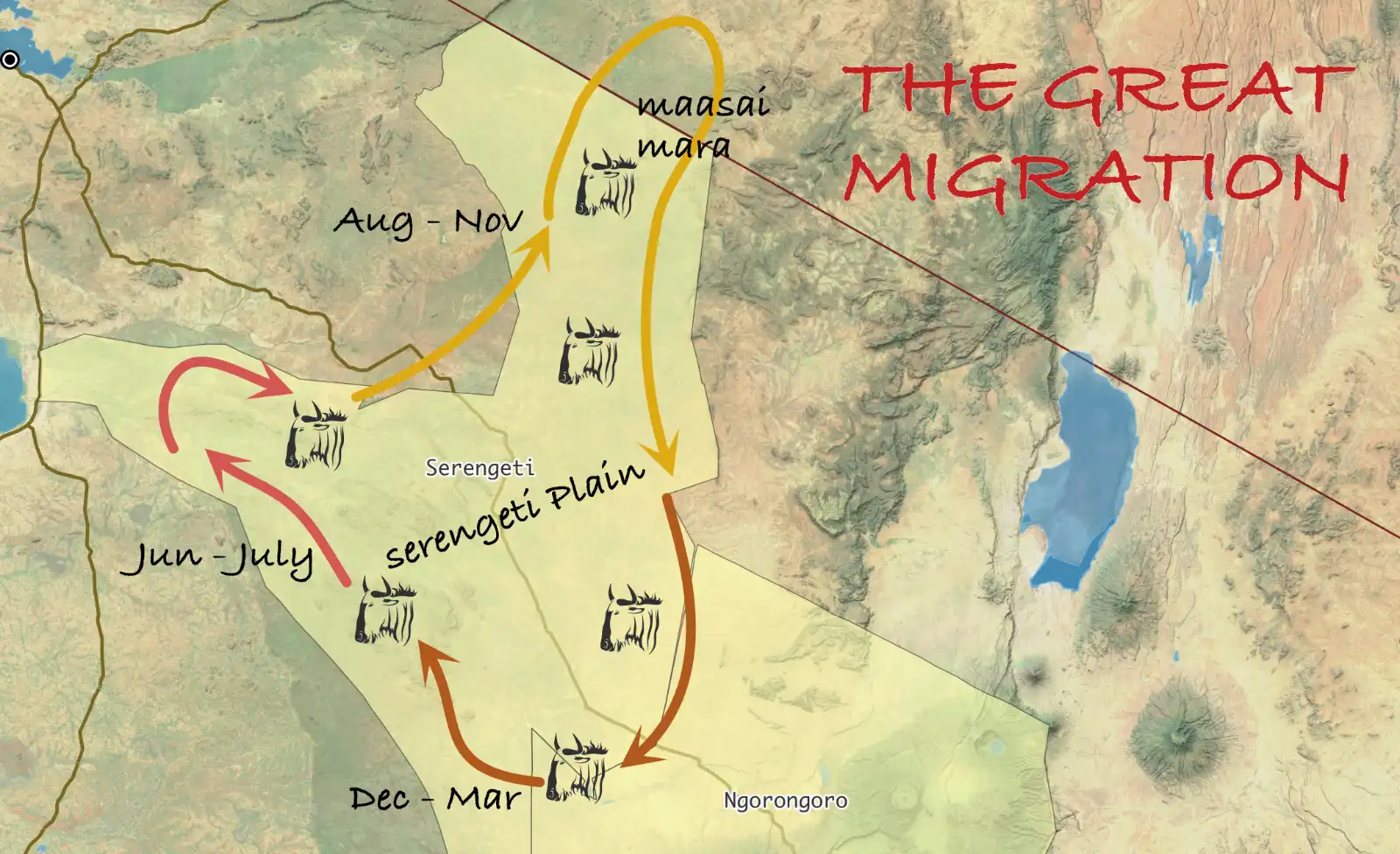
Migration by Month
There is no bad time to see the migration — only different chapters of the same year-round story. The question is which chapter most interests you.
✈️ Plan Your Migration Safari
The Great Migration is among the most reliably spectacular wildlife experiences on Earth — but seeing it well requires understanding which experience you're seeking, which location suits it, and which time of year aligns with your travel calendar.
Porcupine Tours has been guiding guests through every phase of the migration with local Tanzanian expertise that no international operator can match. Our guides know the Serengeti National Park not from textbooks but from years of daily experience reading the land, following the rains, and understanding the rhythms that no migration calendar can fully capture.
**For calving season (January–March, right now):** Our 7-Day Calving Migration Safari takes you into the Ndutu plains during peak calving, combines it with the Ngorongoro Crater and central Serengeti, and gives you access to the best calving guides in southern Tanzania.
**For Mara River crossings (July–October):** Our Mystery of Wildebeest Migration and Zanzibar positions you on the northern Serengeti's Tanzanian side — the crossings and the drama, without the congestion of the Kenyan side, with an optional beach extension.
**For a complete Serengeti experience:** Our 6-Day Jewels of Tanzania Safari and 11-Day Safari Adventure with Zanzibar cover the Serengeti alongside Tarangire National Park and Ngorongoro — a complete Tanzania experience whatever the migration timing.
Whatever month you can travel, the migration will be somewhere in its annual cycle. Contact us and tell us your dates — we will tell you exactly what you'll witness, where, and why it is worth every kilometre of the journey.
Whatever month you can travel, the migration is there. The question we answer for every guest is simple: which chapter of this extraordinary story do you want to witness?
A Final Thought
The Great Wildebeest Migration has been running without pause for at least one million years. It survived the deep freeze of the last ice age. It nearly didn't survive the 1890s rinderpest epidemic. It persists today because Tanzania chose, decades ago, to protect the ecosystem that makes it possible — and because the revenue from visitors who come to witness it funds the conservation work that keeps it safe.
When you sit on the bank of the Mara River waiting for a crossing that may or may not come, or when you stand on the Ndutu plains watching a wildebeest give birth in the first light of a February morning, you are participating in something ancient and fragile and improbably still alive. That is the migration. Not just the crossing. All of it.
Written by Porcupine Tours — Your local Tanzania safari experts
Get in touch to plan your safari