Quick Takeaways (14 min read)
- ▸Ngorongoro is the world's largest intact volcanic caldera at 260 km² — home to 25,000 resident animals who never need to migrate
- ▸One of the very few places in Africa where you can reliably see all of the Big Five in a single day
- ▸Fewer than 30 black rhinos remain on the crater floor — one of the last viable populations in East Africa
- ▸The caldera creates its own microclimate: the rim at 2,286 m is often cold and foggy while the floor basks in sunshine below
- ▸No bad season to visit — resident wildlife means every month of the year delivers guaranteed sightings
The road down into the Ngorongoro Crater begins at the rim, 2,286 metres above sea level, where montane forest clings to the walls and clouds move across the caldera floor far below. Then the track curves inward and descends, switchback by switchback, through a drop of nearly 600 metres. When you reach the bottom and the forest gives way to open grassland, the sensation is immediate: you are inside something. The walls rise in every direction. And within those walls, 25,000 animals are going about their lives — permanent residents of the most remarkable enclosed ecosystem in Africa.
The Formation Story
Ngorongoro was once a vast shield volcano. Geologists estimate it stood roughly 4,500 to 5,000 metres above sea level — comparable in scale to Kilimanjaro. Between two and three million years ago, a massive eruption emptied the magma chamber below, and the unsupported summit collapsed inward on itself. What remained was a caldera: a bowl-shaped depression of approximately 260 square kilometres, enclosed by walls rising 400 to 600 metres above the floor.
The result is the largest intact, unflooded volcanic caldera in the world. Its floor sits roughly 2,000 metres above sea level. The crater measures approximately 19 kilometres in diameter and 14.5 kilometres at its narrowest crossing — large enough that from the rim, the far wall appears as a faint line on the horizon. The scale is something photographs consistently underrepresent.
UNESCO designated Ngorongoro a World Heritage Site in 1979, initially for its geological significance and later for its extraordinary biodiversity. The broader Ngorongoro Conservation Area encompasses 8,292 square kilometres, including Olduvai Gorge — where the Leakey family unearthed some of the oldest hominid fossils ever found. The Olduvai Gorge discoveries established the Ngorongoro highlands as one of the most important archaeological sites in human history, adding a dimension to the landscape that goes far beyond wildlife.
The same volcanic forces that created the Ngorongoro caldera also shaped the wider northern Tanzania landscape. The Serengeti plains, Lake Manyara's rift escarpment, and the still-active Ol Doinyo Lengai volcano are all expressions of the same tectonic story. Ngorongoro is its most dramatic chapter.

What Lives Inside the Crater
The defining fact about Ngorongoro's wildlife is one that most visitors only fully grasp once they are standing on the crater floor: these animals do not migrate. There is no season when the caldera empties. No dry-season exodus, no wet-season dispersal. Approximately 25,000 large mammals live here permanently, sustained by the crater's own microclimate, its permanent water sources, and its year-round grass.
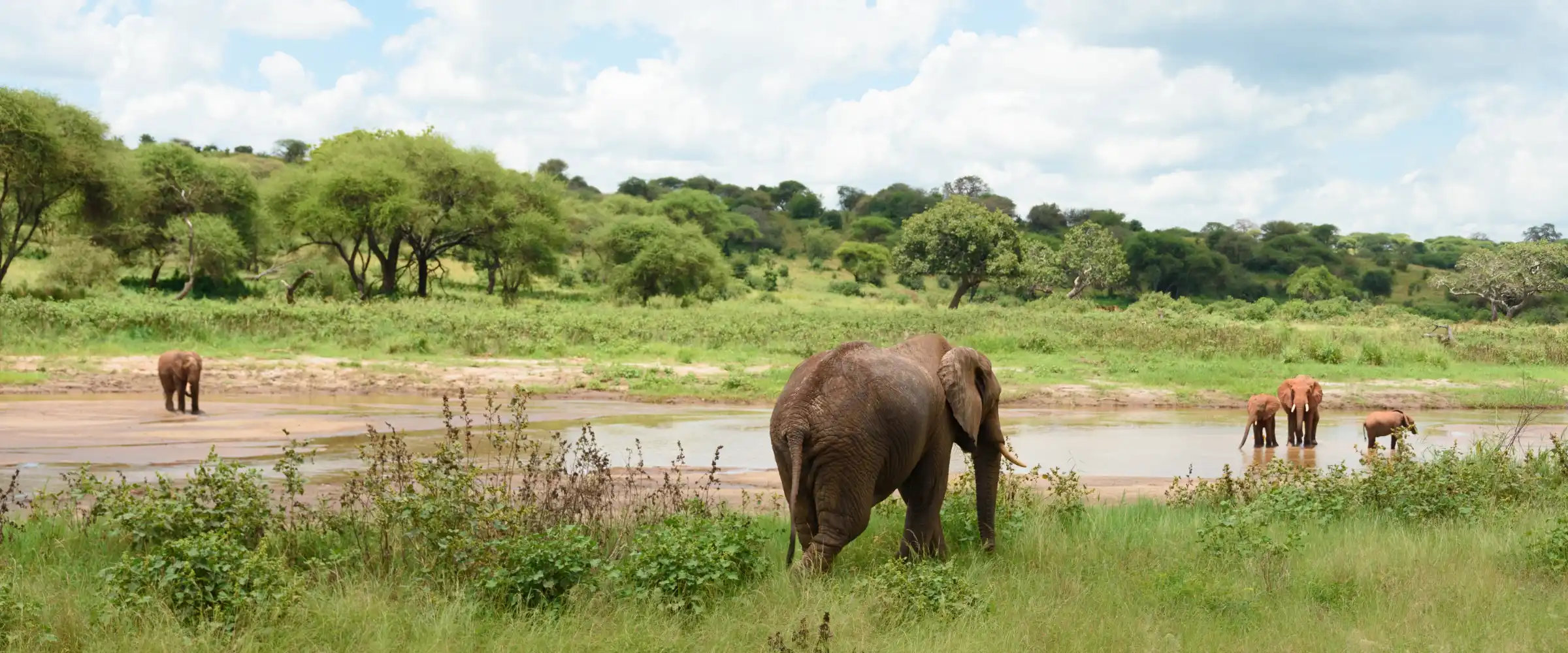
All members of the Big Five are present. Lions appear in concentrations that would be remarkable in any other African park — a density of approximately 62 lions per 100 square kilometres makes this one of the highest lion densities on the continent. Several resident prides hold territories across the floor, and encounters on a full-day game drive are virtually guaranteed. Leopards inhabit the Lerai Forest acacia woodland, where thick canopy and rocky outcrops provide cover. Elephants move through the same forest in small family groups — the bulls that descend into the crater tend to be older and unusually large, carrying tusks rarely seen in other Tanzanian parks. Cape buffalo graze the open plains in herds that can exceed 1,000 animals during the dry season. And then there is the black rhino, which deserves its own section.
Beyond the Big Five, the crater floor hosts wildebeest, zebra, Thomson's gazelle, Grant's gazelle, eland, waterbuck, reedbuck, hippos, spotted hyenas, jackals, cheetahs, and over 400 bird species. The density of predators and prey creates interactions of a frequency and proximity that is difficult to find elsewhere in Africa. It is entirely common to witness a lion hunt, a hyena standoff, and a rhino sighting within a single morning on the crater floor.
Ngorongoro Crater supports approximately 62 lions per 100 square kilometres — one of the highest lion densities anywhere in Africa — and none of the resident animals ever need to leave.
The Black Rhino Sanctuary
Of all the wildlife encounters possible within Ngorongoro Crater, a black rhino sighting carries particular weight. Fewer than 30 black rhinos remain on the crater floor — a small, critically managed population representing one of the last viable concentrations of the species in East Africa.
The story of what happened to Tanzania's black rhinos cannot be separated from the broader poaching crisis of the 1970s and 1980s. Before the crisis, the Ngorongoro population numbered over 100 individuals. By the early 1990s, relentless poaching for horn had reduced this to approximately 11 animals. The collapse was near-total, and recovery has been slow by necessity. Black rhinos are solitary and territorial, with low reproductive rates: females produce a single calf every two to four years, and calves remain dependent for up to three years. A population of 11 takes decades to rebuild even under ideal protection.
The current population of approximately 25 to 30 individuals represents genuine conservation progress. The NCAA — the Ngorongoro Conservation Area Authority — maintains a dedicated anti-poaching unit with intensive monitoring of every known individual. Each rhino is named, tracked, and regularly observed. The crater's enclosed geography works in conservation's favour: the walls provide natural containment, making it possible to monitor the population with a precision impossible in open savanna.
Black rhinos are most reliably encountered in the early morning, when they graze on the short-grass plains before the day heats. Unlike white rhinos, black rhinos are primarily browsers, using their hooked upper lip to tear leaves and bark from shrubs and trees. But the open crater floor means that when they do appear on the grassland, they are visible from considerable distance. A sighting against the backdrop of the caldera walls, with 600 metres of volcanic geology rising behind the animal, is among the most compelling wildlife encounters in Tanzania.

Fewer than 30 black rhinos remain on the Ngorongoro Crater floor — one of the last viable concentrations in East Africa, recovering slowly from the devastation of the 1980s poaching crisis.
Reading the Crater Floor
The 260-square-kilometre crater floor is not a single uniform habitat. It is a collection of distinct ecological zones, and understanding how they fit together transforms a game drive from a sequence of sightings into something closer to a guided story of the caldera.

The open short-grass plains cover the majority of the floor and constitute the primary habitat for wildebeest, zebra, gazelle, and the crater's large predator populations. Historical records describe considerably more woodland cover on the floor in earlier periods — much of it browsed away by increasing elephant numbers and never fully regenerated. The result is exceptional visibility: on the open plains, you can see a kilometre in every direction, which is why predator encounters are so frequent and so well framed for photography.
Lake Magadi occupies the southwestern crater floor — a shallow, alkaline lake that serves as the caldera's permanent water anchor. In the wet season, the lake draws hundreds of flamingos whose pink mass is visible from the rim above. Hippos occupy the deeper pools. Wading birds — avocets, stilts, spoonbills — work the shallows. During the dry season, the lake remains the single most reliable concentration point for wildlife across the floor.
The Lerai Forest runs along the southeastern wall: a grove of yellow-barked fever trees and fig forest that provides cover for elephants, leopards, and olive baboons. Driving through Lerai in the early morning, when shafts of light angle through the canopy and elephants move between the trees, is a very different experience from the open plains — quieter, more intimate, more likely to reward patience.
The Gorigor Swamp in the western sector is seasonal but consistently productive. Buffalo and waterbuck concentrate here in large numbers, and it is one of the more reliable areas in the crater for serval cat sightings. Ngoitokitok Springs, near the eastern wall, is a permanent freshwater source that draws elephants throughout the day. The designated picnic area here is one of the few places on the crater floor where guests can step outside the vehicle — watching elephants at a spring while eating lunch, with the caldera walls surrounding the scene, belongs in a category of experience that no advance description quite captures.
The Crater Floor at a Glance
The Ngorongoro Crater floor contains six distinct habitat zones across 260 km² — understanding each one turns a game drive from a series of sightings into a guided narrative of the caldera ecosystem.
Rim and Fog
The Ngorongoro Crater has its own microclimate, and visiting without understanding it leads to confusion that simple preparation would entirely prevent.
The crater creates its own weather. Moisture-laden air from the east rises against the caldera walls, cools, and condenses as it reaches the rim at 2,286 metres. The result is that the rim — where all the lodges sit — is frequently cold, wet, and wrapped in cloud, even during the dry season. Mist rolls across the rim in the afternoons and evenings. Early mornings can be genuinely cold: temperatures below 10°C are common, and guests regularly underestimate how different the rim feels after the warmth of the Serengeti plains below.
The crater floor, 600 metres lower, operates in a sunnier, warmer microclimate for much of the day. The descent through the walls burns through cloud into clarity. This contrast — fog and montane forest above, golden open savanna below — is part of what makes the spatial experience of Ngorongoro so distinct from any other park. The transition happens gradually on the drive down, and it is one of the quietly memorable parts of any crater visit.
Timing matters. Vehicle access to the crater floor is managed by the NCAA and timed to prevent overcrowding: vehicles must ascend by 6pm, and the number permitted on the floor at any time is regulated. The optimal strategy is an early descent — gates open at 6am — to reach the floor before midday heat reduces animal activity. A full day on the floor gives you nine to ten hours to cover all habitat zones without rushing any of them.

The crater rim at 2,286 metres is frequently cold, wet, and cloud-wrapped while the floor 600 metres below basks in clear savanna light — a contrast that defines every Ngorongoro visit.
When to Visit
The honest answer is any month. The resident wildlife population removes the seasonal dependency that shapes safari planning in the Serengeti or Tarangire. There is no wrong time to visit the Ngorongoro Crater.
That said, conditions do vary. The dry season — broadly June through October — produces the most stable game drive conditions. Grass is shorter, making wildlife easier to spot. Roads are firm and accessible. Animal concentrations around permanent water sources peak as seasonal water dries elsewhere. For first-time visitors wanting the highest probability of a Big Five day, dry season is the practical recommendation.
The wet season (November through May) transforms the crater aesthetically. The floor turns vivid green, the lake fills, flamingos return in force, and the light after afternoon rain is extraordinary for photography. Animal encounters feel more exploratory — animals are spread more evenly across the floor rather than concentrated at water sources. Some lower tracks become temporarily challenging in heavy rain, but experienced guides with proper vehicles navigate this comfortably.
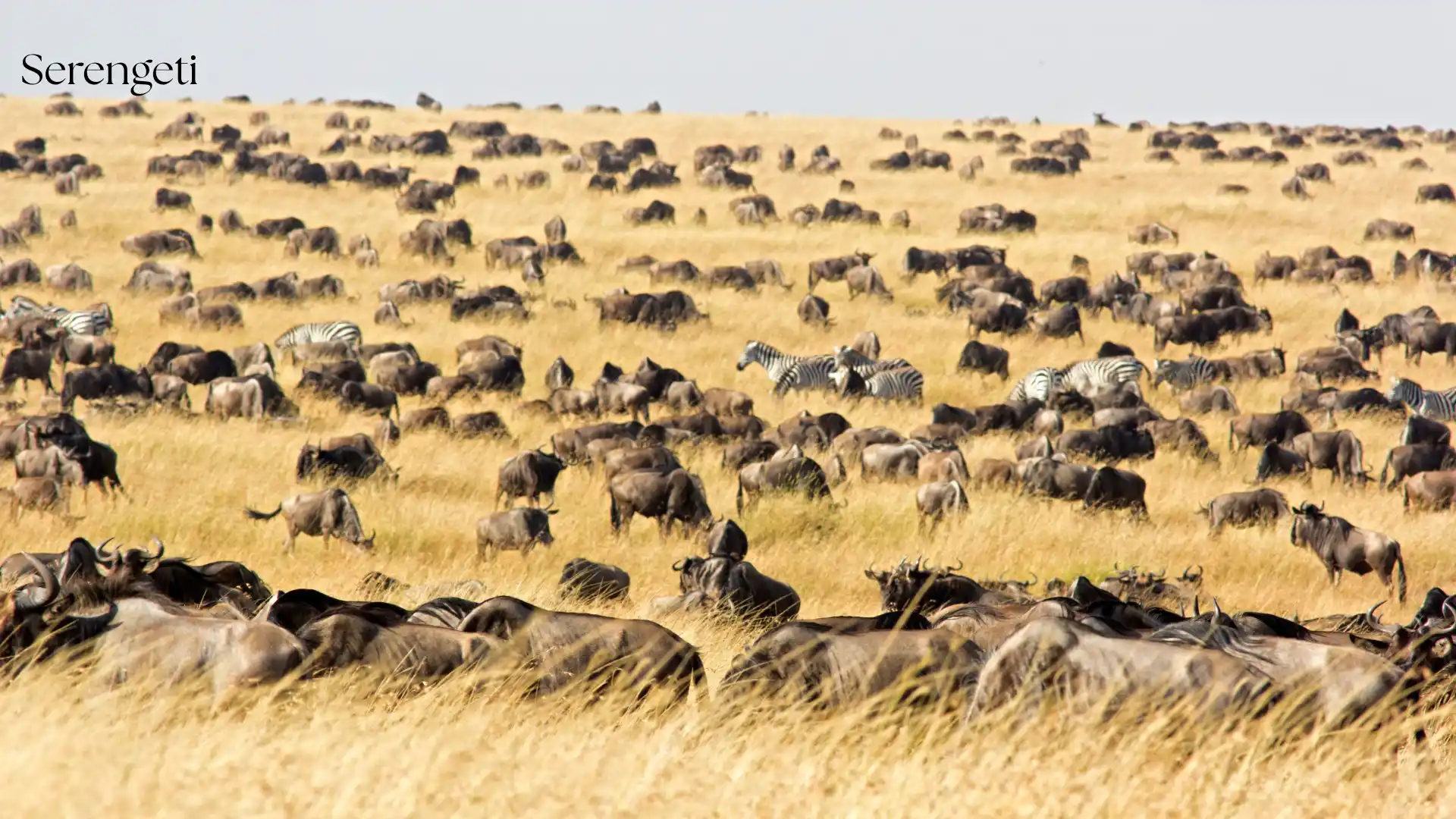
The calving season — which draws wildebeest from the Serengeti to the Ndutu area of the broader Conservation Area between January and March — does not directly affect the crater floor itself. The calving grounds sit outside the caldera, to the south. Many guests combine a crater descent with the calving plains on a single itinerary. Our 7-Day Calving Migration Safari is built around exactly this combination.
When to Visit
Unlike most Tanzanian parks, Ngorongoro Crater has no bad season — 25,000 resident animals make every month viable, with the choice between dry-season visibility and wet-season beauty a matter of personal preference.
Plan Your Ngorongoro Safari
The Ngorongoro Crater is rarely visited alone. Its proximity to Tanzania's other flagship northern circuit parks makes it a natural anchor in a broader safari, and most guests spend one or two nights at crater rim lodges as part of a multi-stop itinerary.
The most natural pairing is with Tarangire National Park, whose vast elephant herds and ancient baobab landscapes provide a strong contrast to the enclosed drama of the caldera. Our 4-Day Tarangire and Ngorongoro Safari covers both parks with two full game-driving days — a compact, high-impact introduction to northern Tanzania.
For a complete northern circuit, the 6-Day Jewels of Tanzania Safari adds the Serengeti National Park, combining the caldera, open savanna, and the world's most significant wildlife migration in a single journey. The 11-Day Safari with Zanzibar extends this further with a beach extension on the Indian Ocean coast — the standard structure for many first-time Tanzania visitors.
Staying on the crater rim is strongly recommended over a day visit from outside. Rim lodges position you for a 6am descent — the single most impactful scheduling decision for a crater visit — and allow you to watch the evening fog roll in across the caldera from your room, an experience unique to this landscape.
Porcupine Tours has been guiding guests into the Ngorongoro Crater with local Tanzanian expertise for years. Our guides know the current rhino sighting history, understand which lion prides are active where, and use that knowledge to build a day on the floor that makes the most of every hour available. Contact us and tell us your dates — we will design the right itinerary around what the crater is doing when you arrive.
The Ngorongoro Crater does not require a perfect season, ideal conditions, or a migration window. It requires only that you descend into it — and the rest takes care of itself.
Written by Porcupine Tours — Your local Tanzania safari experts
Get in touch to plan your safari